Category Archives: Critters

31 Days of Life in my Hawaii Day 26:: Critters: Monk Seal

Here in the U.S., back when you were in fourth or fifth grade, your social studies curriculum probably had you learning all about your home state.

This would include history, both natural and political, probably subjects like geography and famous people. And of course you’d need to know things like where the state capitol is, and maybe memorize a bunch of other stuff just about your state.

Like all the state symbols.

Along with a state flag and a state song, most states have a state flower, a state bird, a state tree. That’s the minimum. Lots of them have state animals and minerals. From there, states get creative and add things like a state insect (Kentucky: Viceroy Butterfly), a state reptile (California: Desert tortoise), a state nut (Oregon: hazelnut), even a state vegetable (North Carolina: sweet potato).

(You’d be amazed at how many states have milk as their state beverage.)

The state of Hawaii, as you might imagine, has some interesting symbols. Probably the biggest attention-getter, by virtue of its name alone, is our state fish: humuhumunukunukuapua`a. Also, given that we’re surrounded by water, it’s appropriate that we have a state marine mammal: the humpback whale. (California and Alaska also have state marine mammals, and Florida — show-off — has two).

My favorite of all is our state mammal: the Hawaiian monk seal. Its Hawaiian name is `Ilio-holo-i-ka-uaua, “dog that runs in the rough water.” Here’s a little profile of this beautiful creature from the Hawaii Wildlife Fund:

The Hawaiian monk seal (Monachus schauinslandi) is the only truly tropical seal in the world and it is critically endangered. There are fewer than 1100 monk seals remaining in the entire Hawaiian Archipelago.

Monk seals are mostly nocturnal feeders with a very diverse diet including eels, octopus, lobsters and fish. They come up onto land to rest, and to give birth and nurse their young. They are very sensitive to human disturbance at their haul-out sites.

Mother monk seals nurse their pups on the beach for approximately 6 weeks and must not be disturbed. Although their total numbers are decreasing every year in the Northwestern Hawaiian Islands, those monk seals born in the Main Hawaiian Islands are surviving better and need our continued vigilant protection.

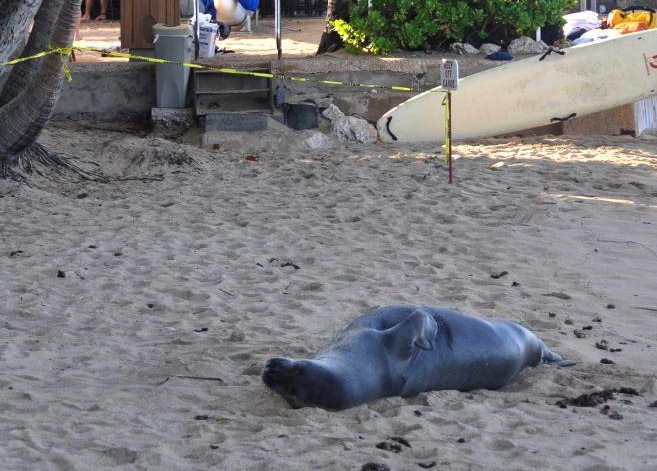
So when a monk seal “hauls out” of the ocean — comes up on land to rest or whatever — people get very excited to actually see one up close. Which isn’t something you’re supposed to do; get too close, that is. That’s why you’ll sometimes see beaches that have little sections roped off with what looks like yellow crime scene tape. It’s to make you keep your distance from our beloved state mammal.

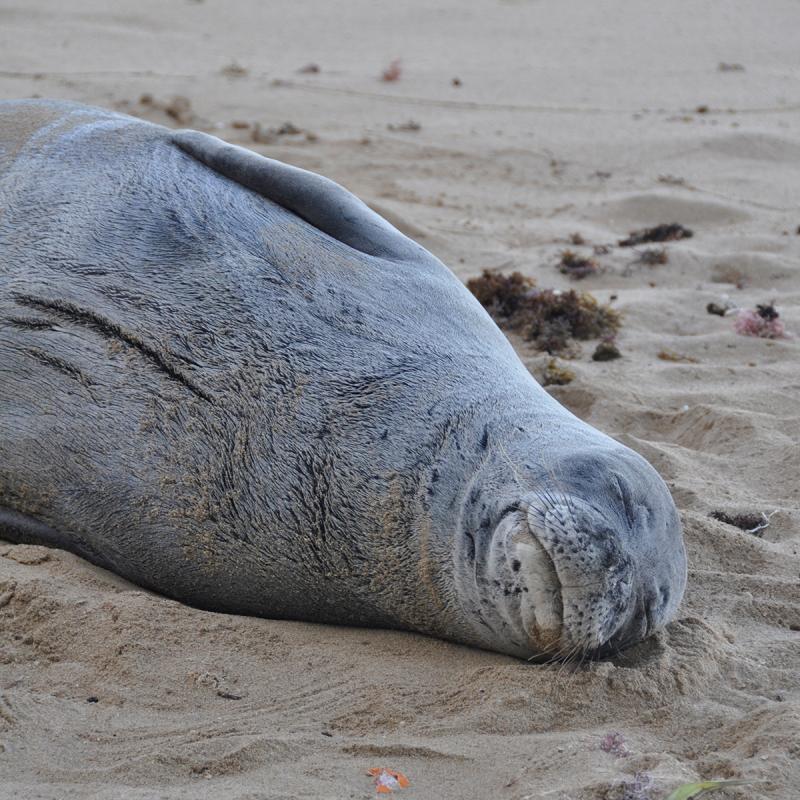
Here’s a couple shots of a monk seal who hauled out to rest in Waikiki not too long ago:
 

This is the twenty-sixth post in my series, 31 Days of Life in my Hawaii. Click here to get the links to the other posts in the series.
31 Days of Life in my Hawaii Day 19:: Critters: Gecko

If you were to spend the night in someone’s home in Hawaii, you might be wakened from sleep by a strange chirping noise.

Something like a cricket on a microphone. Hooked up to a subwoofer.

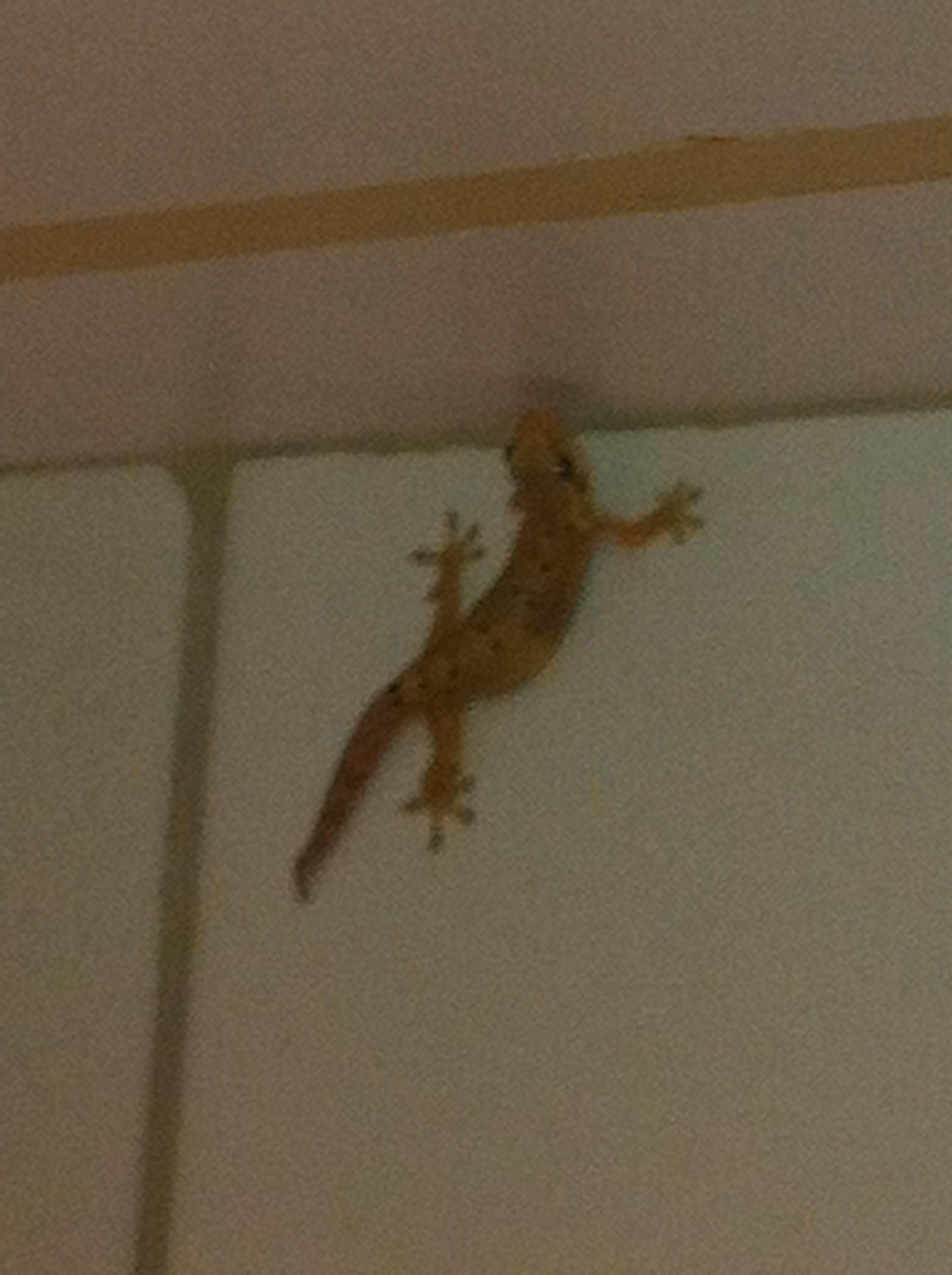
You would find it hard to believe a little critter, not more than four inches from nose to tail, could make such a noise. This is our friend the gecko.

I hasten to clarify that Hawaiian geckos bear little resemblance to the green creature which is the mascot for a certain insurance company. For one thing, our Hawaii geckos are not green, they’re more of a light brown. I guess ours are one of the other 800 species of geckos found around the world.

Folks in Hawaii tend to have mixed feelings about geckos. Some people considers them pests and can’t stand the idea of little beige lizards making themselves at home in our houses. Others — like me — find them harmless and even a little cute, as well as useful for eating bugs like termites, which really are pests.

Here’s my little buddy the gecko who is currently living in my kitchen:

This is the nineteenth post in my series, 31 Days of Life in my Hawaii. Click here to get the links to the other posts in the series.
31 Days of Life in my Hawaii Day 12:: Critters: Mongoose

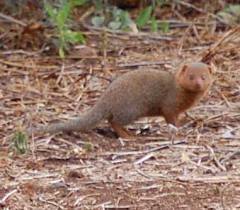
photo credit: ourdems.org

First of all, I’d like to clarify that the plural of mongoose is not mongeese.

It’s mongooses.

Just thought I ought to get that out of the way.

Mongooses were introduced to Hawaii late in the nineteenth century, with the intention of having them help control the rat population, which had gotten out of hand what with all the trans-Pacific ship traffic passing through the islands.

There was only one problem: rats are nocturnal, and mongooses are diurnal. The mongooses were happy to do something about the rat problem, they just weren’t awake at the right time to do it.

Which in turn created another problem: the mongooses needed something to eat, and they have a special liking for eggs. So they turned to a diet of our native species, such as our various forest birds. These are — were — magnificently colored little avian species, highly prized in Hawaiian culture for their feathers. Thanks to the mongoose and other non-native predators, most of these beauties — and several other varieties of Hawaiian bird life — are now, alas, endangered or extinct.

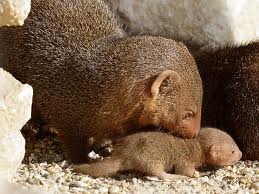
Still, in spite of the destruction they have caused, I have a bit of a fondness for the mongoose. I guess it’s because they’re … cute. There are tons of them on the campus of the school where The Coach works; they live in the shrubbery and you often see them making a dash across the road on their way home. Usually it’s just one hurrying to make it across without getting run over by your car, but often you’ll see a mama followed by a couple babies.

photo credit: redbubble.com

It’s hard to see a scene like that and not say, “Aww.” Although the birds whose eggs are getting eaten probably don’t think so.

This is the twelfth post in my series, 31 Days of Life in my Hawaii. Click here to get the links to the other posts in the series.
31 Days of Life in my Hawaii Day 5:: Critters: Kolea

Those of you in the Northern Hemisphere perhaps are familiar with migratory birds who fly south for the winter.

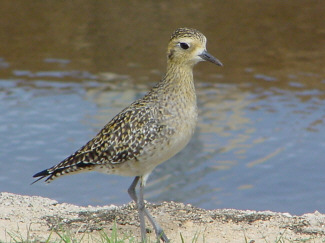
Since we’re, well, sort of the south, most of our birds don’t really go anywhere in the winter. They pretty much stick around all year long. There is one migratory bird, however, who spends winters here and flies north to Alaska for the summers: kolea, the Pacific golden plover.

photo credit: alohafriendsluau.com

The story of how this little critter does this every year is fascinating:

Maybe because they are only here for part of each year, we have a special fondness for kolea. Also, their personalities and proclivities make them intriguing to observe.

For one thing, they tend to be solitary: they don’t hang around with others of their kind. It’s almost as if they take great pride in their own self-reliance. Or maybe they’re just not friendly.

For another, they’re very territorial. They have their favorite spots to alight and graze for food, and not only do they tend to camp out in that spot for the months they are here, but woe to the bird who tries to move in on that space — almost certainly a fight will ensue.

And, as with other birds, they tend to be standoffish towards people. They are really hard to get near to; I see several along the way on my morning walk, but every time I try to get a picture of one, no matter how quiet and cautious I am, it will give me a stink eye and fly away.

In spite of all this general antisocialness, people get excited each August to see “their” birds back in their neighborhoods, and feel a certain sadness when the last one leaves in April. It somehow feels like a kind of blessing when you have one that makes your property its winter habitat.

The other day as I was leaving the house, I saw “our” kolea checking out our front yard for worms:

Kolea won’t let me get too close. Maybe he just wants me to get out of “his” yard.

Here in Hawaii we love our kolea. Do you feel that way about your migratory birds?

This is the fifth post in my series, 31 Days of Life in my Hawaii. Click here to get the links to the other posts in the series.